How to Become a Master Distributor in Mobile Recharge Business in India
Step-by-step guide to becoming a master distributor in India's mobile recharge business — investment, roles, margins, and how to build a profitable downline network.
How to Become a Master Distributor in Mobile Recharge Business in India
India's mobile recharge distribution business runs on a multi-level channel model. At the base are retailers who serve end customers directly. Above them are distributors who manage retailer networks. And above distributors sits one of the most profitable positions in the entire chain — the master distributor.
A master distributor controls a large downline of distributors and retailers, earns margin on every transaction processed by their entire network, and operates with significantly higher income potential than any single-level participant. If you are already in the recharge business or looking to enter it at a serious level, becoming a master distributor is the logical step up.
This guide explains exactly what a master distributor does, how much you can earn, what investment is required, and what software and setup you need to run the role professionally.
What Is a Master Distributor in Recharge Business?
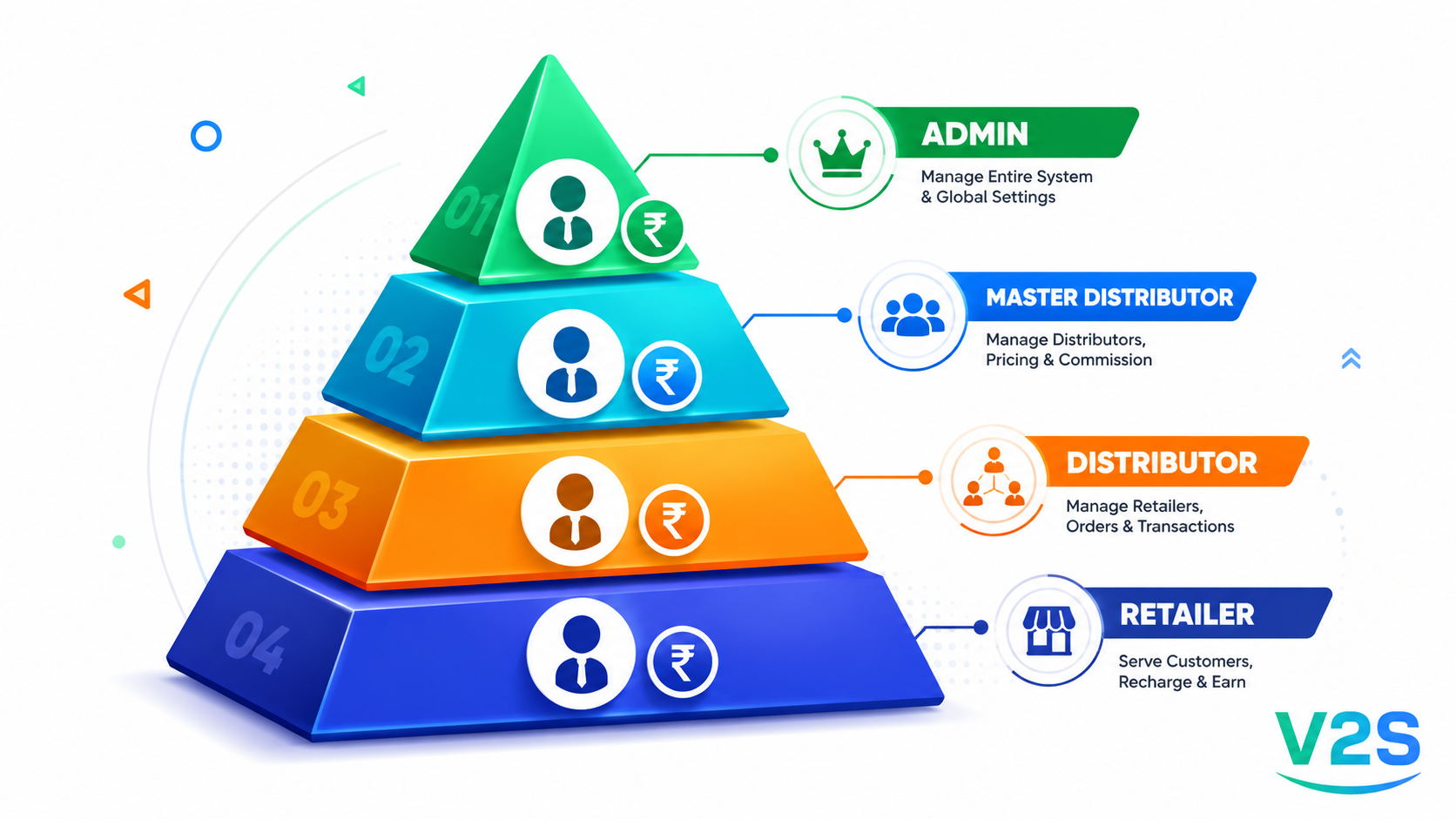
In a B2B mobile recharge software model, the channel hierarchy typically works like this:
- Admin — owns and controls the entire platform, all APIs, all accounts
- Master Distributor — manages a network of distributors, controls fund allocation, earns margin from entire downline
- Distributor — manages retailers, transfers wallet balance, earns margin from retailers
- Retailer — serves end customers, performs actual recharges and bill payments
The master distributor sits between the admin and the distributor level. They do not do recharges themselves — they build and manage a network of distributors who each build networks of retailers. Their income comes from the margin difference between what they buy balance at and what they sell it to distributors.
In a well-structured network, a master distributor with 10 active distributors, each managing 20 retailers, has 200 retailers processing transactions daily — and earns a cut from every single one of those transactions.
Master Distributor vs Distributor — Key Differences
- Scale: A distributor manages retailers directly. A master distributor manages distributors who manage retailers — one extra level of leverage.
- Income: A distributor earns margin from their own retailers only. A master distributor earns from all distributors and retailers in their downline.
- Investment: Master distributor role requires higher wallet balance to fund a larger downline.
- Responsibility: Master distributors handle fund allocation, dispute resolution, and onboarding for their distributor network — more operational involvement than a retailer but less hands-on than doing recharges yourself.
- Control: In most B2B recharge software platforms, a master distributor has their own dashboard, their own login, and full visibility into their downline's transactions and balances.
How Much Can a Master Distributor Earn?
Earnings depend on network size, transaction volume, and the commission slabs set by your admin. Here are realistic figures based on active networks in India:
- Mobile recharge commission: 1–4% per transaction
- DTH recharge commission: 2–3% per transaction
- BBPS bill payments (electricity, broadband, postpaid): ₹3–₹15 per transaction or 0.5–2%
- AePS cash withdrawal: ₹5–₹15 per transaction
- DMT money transfer: 0.4–1% per transaction
To understand what this means in monthly income, consider a realistic scenario:
- You have 8 active distributors in your network
- Each distributor manages 15–20 retailers
- Each retailer processes ₹5,000–₹10,000 in recharge and bill payments per day
At 1–2% margin on a combined daily transaction volume of ₹8–16 lakhs across your full network, a master distributor can realistically earn ₹15,000–₹40,000 per month. Networks with higher transaction volumes, AePS, and DMT services added can push this significantly higher.
This is passive income in the truest sense — your distributors and retailers are doing the work, you are earning from the volume.
What Investment Is Required?
There is no fixed "master distributor fee" in a B2B software model the way there is in traditional franchises. Your actual investment has two parts:
1. Software Subscription
You need a B2B recharge software with multi-level channel support to manage your distributors and retailers properly. A platform like V2S Infosystem's starts at ₹1,499/month for a 4-channel setup (Admin, Master Distributor, Distributor, Retailer) and ₹1,999/month for a 5-channel setup that adds Super Distributor and includes a white-label admin panel.
This is not a one-time purchase — it is a low monthly cost that keeps the platform running, updated, and supported. There is no large upfront investment.
2. Wallet Balance (Working Capital)
You need enough wallet balance to fund your downline distributors. If you have 8 distributors and each needs ₹10,000–₹20,000 in balance to serve their retailers, you need ₹80,000–₹1,60,000 in working capital available at any time. This rotates — it comes back as retailers recharge and the money flows up the chain.
3. API Integration (One-Time)
Each recharge API operator connection costs ₹1,000–₹5,000 as a one-time setup fee. You typically need 2–4 API providers for redundancy — so budget ₹5,000–₹15,000 for this one-time setup.
Step-by-Step: How to Become a Master Distributor
Step 1 — Understand the Business Model First
Before investing, be clear on how the money flows. You buy wallet balance from your admin at a lower rate. You transfer balance to your distributors at a slightly higher rate. The difference is your margin. Every recharge or bill payment processed by anyone in your downline generates a small but consistent margin for you.
The business scales with network size — the more active distributors and retailers you have, the higher your monthly earnings. Your job is network building and fund management, not doing recharges yourself.
Step 2 — Choose the Right Software
This is the most important decision. The software you pick determines what you can offer your distributors and retailers, how well you can track your network, and how much control you have over your operations.
Look for software that gives you:
- A dedicated master distributor login and dashboard
- Full downline visibility — see every distributor's and retailer's transactions and balance
- Wallet transfer controls — you decide how much balance each distributor gets
- Commission management — configure margins per service and per level
- Multiple recharge API support — so your network never faces a failed recharge due to a single API going down
- BBPS, AePS, and DMT support — these services significantly increase your earning per retailer
- Android app — so your retailers can operate from their mobile without needing a computer
A platform without these capabilities will limit your network's growth and reliability. See the complete feature list of V2S Infosystem's recharge software to understand what a serious platform looks like.
Step 3 — Set Up Your API Connections
Once you have your software, connect at least 2 recharge API providers. Having a primary and a backup API ensures that if one API is slow or down, your retailers' transactions still go through on the secondary. This directly affects retailer satisfaction and retention in your network.
The V2S Infosystem platform supports unlimited APIs with primary and secondary routing per operator — if the primary fails, it automatically switches to the backup without any manual action required.
Step 4 — Build Your Distributor Network
Start with 3–5 distributors you already know and trust — existing shopkeepers, CSC operators, or mobile accessory shop owners in your city or district. Give them a hands-on walkthrough of the retailer panel. Show them how to recharge, how to check balance, how to request funds.
Each distributor then builds their own retailer network. Your job is to keep your distributors funded, resolve escalations they cannot handle, and add more distributors as your working capital grows.
Step 5 — Add High-Margin Services to Your Network
Mobile recharge alone is not the highest margin service. The businesses that earn more from their networks are the ones that add:
- BBPS bill payments — electricity bills alone generate ₹3–₹15 per transaction and volume is extremely high, especially around bill due dates
- AePS banking — cash withdrawal via Aadhaar earns ₹5–₹15 per transaction and serves the unbanked population which has no alternative
- DMT money transfer — migrant workers sending money home is a daily recurring transaction; at 0.4–1% per transfer, volume adds up fast
A retailer who only does mobile recharge earns ₹3,000–₹8,000 per month. A retailer who also does AePS and DMT earns ₹8,000–₹20,000 per month. More earning per retailer means more transaction volume flowing through your master distributor account.
Step 6 — Manage Your Working Capital Carefully
The most common mistake new master distributors make is over-extending their wallet balance across too many distributors too quickly. Keep these rules in mind:
- Only give as much balance as a distributor's daily transaction volume justifies
- Review distributor performance weekly — inactive distributors tie up capital
- Keep a buffer — never distribute 100% of your balance. Keep 15–20% reserved for emergency top-ups
- Use ledger reports in your software to track every transfer and transaction
Step 7 — Scale Gradually
Once your first 5 distributors are active and generating consistent volume, add 5 more. Then 5 more. Scaling too fast before your processes are stable leads to disputes, fund management errors, and churn. Scale at the pace your working capital and management bandwidth allows.
Common Mistakes to Avoid
- Choosing software based on price alone: Cheap software with poor API routing means failed recharges, which means retailers switch to competitors. Reliability is worth the subscription cost.
- Not having backup APIs: A single API going down for a few hours can cause your entire retail network to lose business that day. Always have a secondary API configured.
- Ignoring AePS and DMT: These services take 10 minutes to enable in good software and can double your network's earning per retailer.
- Not tracking distributor performance: Use your software's reporting tools. A distributor who has not transacted in 2 weeks is either stuck or inactive — follow up immediately.
- Over-relying on a single distributor: If 60% of your volume comes from one distributor, your income is at risk if they leave. Spread your network.
Is the Master Distributor Role Right for You?
The master distributor role suits people who:
- Already have some experience in recharge or distribution business and want to scale
- Have working capital of ₹1–3 lakhs to manage a distributor network
- Are comfortable managing people and resolving disputes
- Want passive network income rather than doing transactions personally
- Are based in a city or district where they can build and monitor an on-ground network
If you are completely new to recharge business, start as a distributor first. Understand how the software works, how APIs behave, and how to manage retailers — then step up to master distributor once you have a working knowledge of the business. Read our guide on how to become a recharge distributor in India as your starting point.
Frequently Asked Questions
What is the difference between a master distributor and a distributor?
A distributor manages retailers directly and earns margin from their transactions. A master distributor manages distributors who in turn manage retailers — one level higher, with earnings coming from the entire downline. The income potential is significantly higher but so is the working capital required.
How much working capital do I need to become a master distributor?
It depends on the size of your distributor network. As a starting point, budget ₹1–3 lakhs in wallet balance to fund 5–10 active distributors comfortably. This money is not spent — it circulates as your network processes transactions and balance flows up the chain.
Do I need technical knowledge to operate as a master distributor?
No. Modern B2B recharge software is designed so that master distributors and distributors can operate entirely from a web dashboard or Android app — no coding, no IT background required. The admin handles API setup; you handle network management.
How many distributors can I add under my master distributor account?
On V2S Infosystem's platform, there is no fixed limit. You can add as many distributors as your working capital and management capacity allows.
Can a master distributor also earn from BBPS, AePS, and DMT?
Yes — and this is where serious income comes from. Every transaction your retailers process, whether it is a mobile recharge, electricity bill, AePS cash withdrawal, or DMT transfer, generates margin that flows up through the distributor to you. The more services your network offers, the higher the per-retailer transaction volume and the higher your earnings.
What software do I need to manage a master distributor network?
You need a B2B recharge software with multi-level channel support, dedicated master distributor login, wallet management, commission controls, and reporting. V2S Infosystem's platform supports 4-channel and 5-channel models starting at ₹1,499/month. See the full features list or visit the B2B admin panel page for plan details.
Can I start as a master distributor on a monthly subscription instead of a big upfront cost?
Yes. V2S Infosystem's software runs on a monthly subscription — ₹1,499/month for the standard plan, ₹1,999/month for the white-label plan. There is no large one-time software purchase. Your only upfront cost is the API integration setup (₹1,000–₹5,000 per API, one-time) and your working capital for distributor wallet funding.
Ready to build your own recharge distribution network? View our B2B recharge software plans → | Talk to the V2S team →