Custom Software vs Off-the-Shelf: Which Is Right for Your Business?
Custom software or off-the-shelf SaaS? 5 situations where each wins, a total cost comparison, and 5 questions to help you decide.
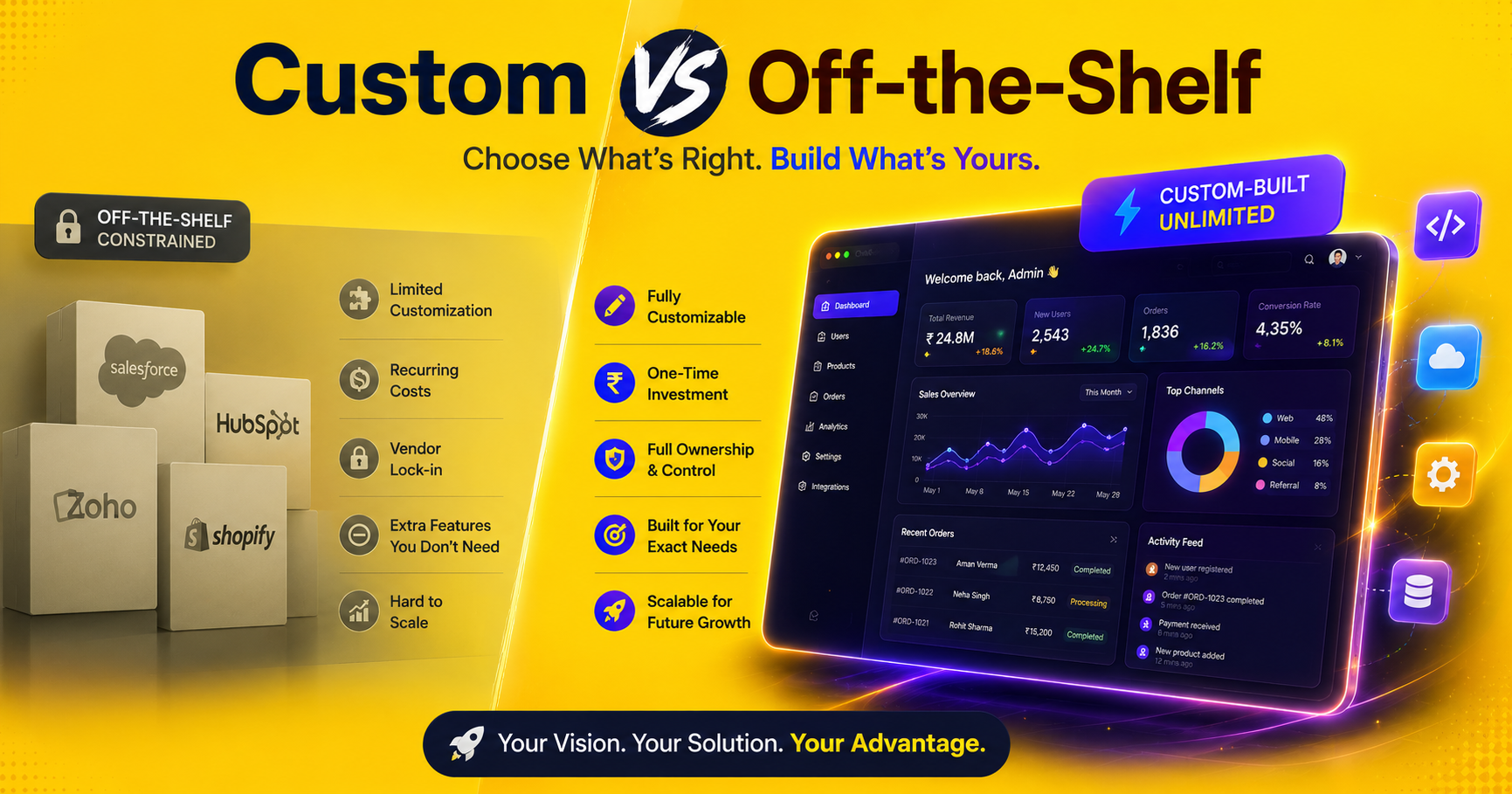
Custom Software vs Off-the-Shelf: Which Is Right for Your Business?
Every business eventually faces this decision: build something custom for your exact needs, or buy an existing product and adapt your processes to fit it. There's no universal answer — but there is a logical framework for making the right call.
This guide gives you a clear comparison, real cost numbers, and five questions to ask yourself before you commit to either path.
What Is Off-the-Shelf Software?
Off-the-shelf software (also called packaged software or SaaS) is built for a broad market. Products like Zoho CRM, Tally, QuickBooks, Shopify, or Freshdesk are designed to serve thousands of businesses across many industries. You subscribe, configure, and use it — but you can't fundamentally change how it works.
What Is Custom Software?
Custom software is built specifically for your business — your workflows, your data structure, your user roles, your integrations. No two businesses get the same product. You own the code, the data, and the direction the software evolves.
5 Situations Where Off-the-Shelf Wins
1. Your Process Is Standard
If your business does accounting, HR payroll, basic CRM, or email marketing the same way most businesses do it, off-the-shelf handles it well. You don't need custom code to send invoices the way everyone else sends invoices.
2. You're Early Stage and Need Speed
Getting to market in 2 weeks with Shopify beats spending 4 months building a custom e-commerce platform when you don't yet know if the business model works. Validate first, build custom later.
3. Budget Is Very Tight Short-Term
A ₹5,000/month SaaS subscription is accessible when a ₹15L custom build is not. If cash flow is a constraint and the feature gap is tolerable, off-the-shelf is rational.
4. The Category Has a Dominant Product
Some categories have products so good that building custom is hard to justify — Google Workspace for email, Zoom for video calls, Razorpay for payments. Custom doesn't beat them; integrate with them instead.
5. You Need Minimal Customisation
If the workflow fits 90% of what you need and you can work around the 10% gap, the off-the-shelf product might serve you fine. Evaluate whether the gap is genuinely painful or just unfamiliar.
5 Situations Where Custom Software Wins
1. Your Process Is Your Competitive Advantage
If your operations, pricing logic, workflow, or customer experience is different from your competitors — that difference is valuable. Off-the-shelf forces you to operate like everyone else. Custom software lets your advantage compound.
2. You've Outgrown Off-the-Shelf
Most scaling businesses hit this point: the SaaS product that worked at 500 orders/month breaks at 15,000. Workarounds multiply. You're paying for features you don't use and missing ones you desperately need. Custom is the natural next step.
3. The Integration Puzzle Is Unsolvable
If you're running 5 different SaaS products that don't talk to each other, and your team is manually copying data between them every day — the hidden cost of that friction often exceeds the cost of a custom unified system.
4. Compliance or Security Requires It
Regulated industries — healthcare, finance, legal, government — often can't put their data in third-party SaaS platforms due to compliance requirements. Custom software deployed on your own infrastructure is sometimes the only legal option.
5. The Per-Seat/Per-Transaction Cost Becomes Unsustainable
SaaS pricing scales with your usage. A platform charging ₹500/user/month looks fine at 10 users. At 200 users it's ₹12L/year — every year, forever. Custom software has a one-time build cost and then only hosting and maintenance. Beyond a certain scale, custom almost always wins on total cost.
3-Year Total Cost Comparison
Off-the-shelf example: Mid-tier CRM at ₹3,000/user/month × 20 users = ₹60,000/month = ₹7.2L/year = ₹21.6L over 3 years. Plus integration costs, consultant fees for customisation, and migration costs if you eventually switch.
Custom software example: ₹12L build cost + ₹1.5L/year hosting and maintenance = ₹16.5L over 3 years. Fully owned, no per-user fees, built exactly for your workflow.
The crossover point varies by team size and complexity, but for teams above 15–20 users on a non-trivial workflow, custom often pays back within 2–3 years.
5 Questions to Help You Decide
1. Is this workflow standard or unique? Standard → try off-the-shelf first. Unique → lean toward custom.
2. What does the 3-year SaaS cost look like? Calculate your total spend including user licences, integrations, and consultants. Compare honestly to a custom build quote.
3. How much of the SaaS product do you actually use? If you're using 20% of the features and paying for 100%, that's a signal.
4. What happens when you hit the platform's limits? Every SaaS platform has ceilings. Find out where they are and whether you'll hit them in 2–3 years.
5. What's the migration cost if you switch later? Starting on off-the-shelf and switching to custom later is possible but has real cost — data migration, process retraining, and downtime. Factor that into your decision now.
The Hybrid Approach
Many businesses use both: off-the-shelf for commodity functions (accounting, HR payroll, email) and custom software for their core operational differentiator (the delivery management system, the client portal, the production workflow tool). You don't have to choose one or the other for everything.
Getting a Custom Software Quote
V2S Infosystem Private Limited builds custom software for Indian and international businesses. If you're evaluating whether custom makes sense for your situation, contact us for a scope and cost estimate — we'll give you an honest assessment, including when off-the-shelf is the better answer.