What is LAPU Recharge Software? Complete Guide for B2B Distributors in India
LAPU recharge software explained — how LAPU API integration works in B2B platforms and why it matters for distributors and retailers in India.
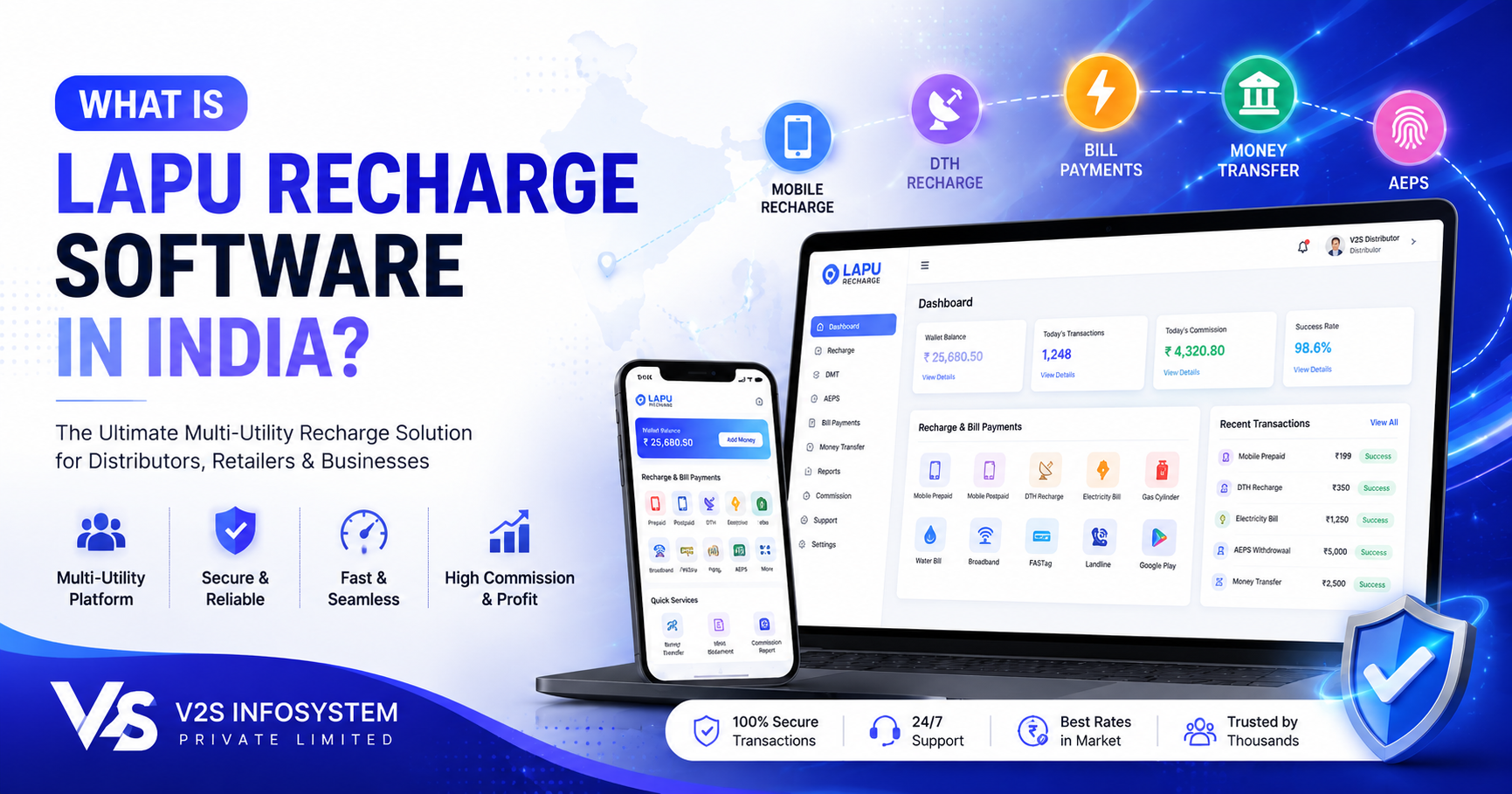
What is LAPU Recharge Software? Complete Guide for B2B Distributors in India
If you operate a B2B mobile recharge business in India, you have likely come across the term LAPU. Whether you are a distributor managing a retailer network or a master distributor planning to expand, understanding LAPU recharge and its role in modern recharge software is essential for staying competitive in India's evolving fintech distribution ecosystem.
LAPU stands for Last Agent Per Unit. It refers to a SIM-based recharge method where a dedicated SIM card — issued by a telecom operator or an authorised distributor — acts as a virtual wallet to process mobile recharges. Unlike standard API-based recharge that routes transactions through software gateways, LAPU recharge works by consuming value from a loaded SIM card using structured commands or an integrated API layer.
In this guide, V2S Infosystem Private Limited explains what LAPU recharge software is, how LAPU API integration works within a B2B recharge platform, and why businesses across India are actively seeking platforms that support LAPU alongside conventional API recharge.
What Is LAPU Recharge?
LAPU is a distribution model used primarily for prepaid mobile recharges. Telecom operators allocate a special SIM card to authorised agents or distributors. This SIM carries a monetary balance, and when a retailer processes a recharge, the value is deducted from the LAPU SIM balance. The end-customer receives the recharge, and the agent earns the margin on the difference between the face value and the load value.
This method has been used extensively by telecom companies across India because it allows operators to distribute recharge capability to ground-level agents without requiring complex server infrastructure. LAPU SIMs are issued by major operators, each with their own commission and margin structures.
The key distinction between LAPU and API recharge is the transaction routing method. API recharge uses software-to-operator HTTP calls; LAPU uses a physical or eSIM as the transaction vehicle. Many distributors prefer LAPU for certain operators because commission margins are sometimes more favourable and the method does not depend on third-party API providers.
What Is LAPU Recharge Software?
LAPU recharge software is a B2B platform that allows distributors, master distributors, and retailers to manage LAPU SIM-based recharges within a structured multi-level channel. The software connects the LAPU SIM's transaction capability to a digital panel, enabling administrators to assign LAPU SIMs to channel partners, track balances, process recharges, and manage commissions from a centralised dashboard.
A strong LAPU recharge software includes LAPU API integration, which means the platform communicates with the LAPU SIM provider's backend through an API layer. This allows the software to trigger LAPU recharges programmatically without manual SIM interaction, making it suitable for high-volume B2B distribution networks.
Important note: V2S Infosystem Private Limited does not offer standalone LAPU software as a separate product. However, the V2S B2B recharge platform is built with an enterprise-grade API gateway that supports easy LAPU API integration. Distributors can connect their existing LAPU API providers to the V2S platform and manage LAPU recharges alongside all other services — prepaid, DTH, BBPS, AePS, DMT, PAN card, and more — from a single admin panel.
How LAPU API Integration Works in B2B Recharge Software
LAPU API integration connects a LAPU SIM provider's API endpoint to your B2B recharge software. Once integrated, retailers on your network can process LAPU recharges through the software's standard interface, without interacting directly with the SIM card. Here is how it works in a multi-level recharge platform with enterprise-grade architecture:
Step 1 — Obtain a LAPU API Provider
Work with a telecom-authorised LAPU SIM provider or LAPU API reseller. They will supply API credentials including an endpoint URL, authentication keys, and request format specifications (GET or POST method).
Step 2 — Configure the API in the Admin Panel
The V2S recharge platform's API gateway module supports both GET and POST methods, multiple content types, custom headers, timeout settings, response pattern matching, and field mapping. Add your LAPU API credentials through the API Gateway settings. The system allows you to assign a unique API name and configure it at identity, endpoint, request payload, response parsing, callback, and routing layers.
Step 3 — Set Operator-Level Routing
Configure which operators or denominations should route through the LAPU API versus standard recharge APIs. The platform supports operator-level primary and secondary routing, amount-based routing, and member-specific overrides — giving you complete control over transaction flow.
Step 4 — Assign Commission Slabs
Set commission margins for your retailer and distributor tiers on LAPU transactions. Mobile recharge commissions typically range between 1–4%, subject to operator and LAPU provider rates. Commission rates are indicative and subject to change based on market conditions and NPCI regulatory guidelines.
Step 5 — Go Live and Monitor
Once configured and tested, your retailers can start processing LAPU recharges. The admin dashboard provides real-time transaction reporting, success/failure tracking, callback monitoring, and audit logs for full visibility across the Admin → Master Distributor → Distributor → Retailer channel.
Why LAPU Recharge Integration Matters for Your Business
For distributors building a multi-level recharge network, LAPU integration adds significant competitive advantage:
- Broader operator coverage: Some operators provide better rates or exclusive denominations through LAPU that are not available via third-party APIs.
- Fallback reliability: When a primary API gateway is down, LAPU can serve as an alternative route, reducing downtime for your retailer network.
- Retailer confidence: Offering LAPU alongside standard recharge signals a mature, operator-connected platform.
- Commission optimisation: Routing certain transactions through LAPU where margins are better increases profitability at every level of your distribution channel.
LAPU vs API Recharge — Key Differences
Understanding the difference helps you make informed routing decisions. For a deeper look at API-based recharge, read our guide on how to choose a mobile recharge API provider in India.
| Parameter | LAPU Recharge | API Recharge |
|---|---|---|
| Transaction Method | SIM-based virtual wallet | Software HTTP API call |
| Commission Source | Telecom operator (direct) | API provider margin |
| Speed | Slightly slower | Faster (server-to-server) |
| Scalability | Limited by SIM capacity | High (multi-provider routing) |
| Best Used For | Specific operators, higher-margin denominations | High-volume multi-operator networks |
Who Should Use a Platform with LAPU Integration?
A B2B recharge platform with LAPU API support is most valuable for:
- Master distributors managing large retailer networks who want maximum operator coverage
- Distributors in tier-2 and tier-3 cities where LAPU SIM-based recharge remains common
- Recharge API resellers who want to offer LAPU alongside their primary API products — read our guide on how to start a recharge API business in India
- Entrepreneurs starting a mobile recharge business in India who want a platform that grows with their network
Common Mistakes to Avoid with LAPU Integration
- Not validating credentials before going live: Always test your LAPU API with small transactions before enabling it for the full retailer network.
- Incorrect routing rules: Misconfigured operator-level routing can send LAPU recharges for operators that do not support it, causing transaction failures.
- Ignoring SIM balance monitoring: A depleted LAPU SIM balance means failures for your entire retailer network. Set up balance alerts.
- Promising fixed commissions: LAPU commission rates can change with operator policies. Always communicate indicative rates with the NPCI disclaimer.
Frequently Asked Questions
What does LAPU stand for in recharge software?
LAPU stands for Last Agent Per Unit. It refers to a SIM-based recharge distribution method where a dedicated SIM card, loaded by a telecom operator or authorised distributor, is used to process prepaid mobile recharges at the retailer level. The SIM carries a virtual balance consumed with each transaction.
Does V2S Infosystem provide LAPU recharge software?
V2S Infosystem Private Limited does not offer standalone LAPU software as a separate product. However, the V2S B2B recharge platform includes an enterprise-grade API gateway with full LAPU API integration support. Distributors connect their existing LAPU API provider to the V2S platform and manage LAPU recharges alongside prepaid, DTH, BBPS, AePS, DMT, PAN card, and all other services from a single admin panel.
What is the difference between LAPU and API recharge?
LAPU recharge uses a physical or eSIM card as the transaction vehicle — value is consumed from the SIM's balance to process recharges. API recharge uses HTTP calls between software and telecom operators or third-party API providers. API recharge is generally faster and more scalable for high-volume networks, while LAPU can offer better commission margins for certain operators and denominations.
Can I use LAPU and API recharge together in one software?
Yes. A well-built B2B recharge platform supports operator-level routing that allows you to route specific operators through LAPU and others through standard API gateways. This hybrid approach maximises coverage, minimises downtime, and optimises commission earnings across the Admin → Master Distributor → Distributor → Retailer distribution channel.
What commission can I earn through LAPU recharge?
Mobile recharge commissions through LAPU typically range from 1–4%, depending on the operator, denomination, and your LAPU SIM provider's margin structure. Commission rates are indicative and subject to change based on market conditions and NPCI regulatory guidelines.
How many API providers can I add to the V2S recharge platform?
The V2S recharge platform's API gateway supports multiple API providers with no hardcoded maximum. You can add as many providers as required — including LAPU, standard HTTP API, and XML API providers — and configure separate routing rules per operator, amount range, or channel member. Both GET and POST methods are supported along with custom headers, response pattern matching, and callback URL configuration.
Is LAPU recharge integration suitable for small distributors?
LAPU integration delivers the most value for distributors already managing a retailer network in areas where SIM-based recharge is common. For those just starting, building a strong API-based foundation first and adding LAPU as the network grows is the recommended approach. Read our guide on how to become a recharge distributor in India to plan your journey effectively.
If you are building a multi-level B2B recharge distribution network and want a platform that supports LAPU API integration, BBPS, AePS, DMT, and every major fintech service from a single enterprise-grade admin panel, explore V2S Infosystem's B2B recharge software or contact our team to discuss your channel requirements.
Looking specifically for a provider to connect your LAPU API to? See our LAPU recharge software provider page for how the integration, routing, and commission setup works.