How to Become a Recharge Distributor in India (2026 Complete Guide)
Learn how to become a recharge distributor in India in 2026. Understand distributor responsibilities, investment requirements, software selection, network building, and how to grow a profitable recharge distribution business using a modern B2B recharge software platform.
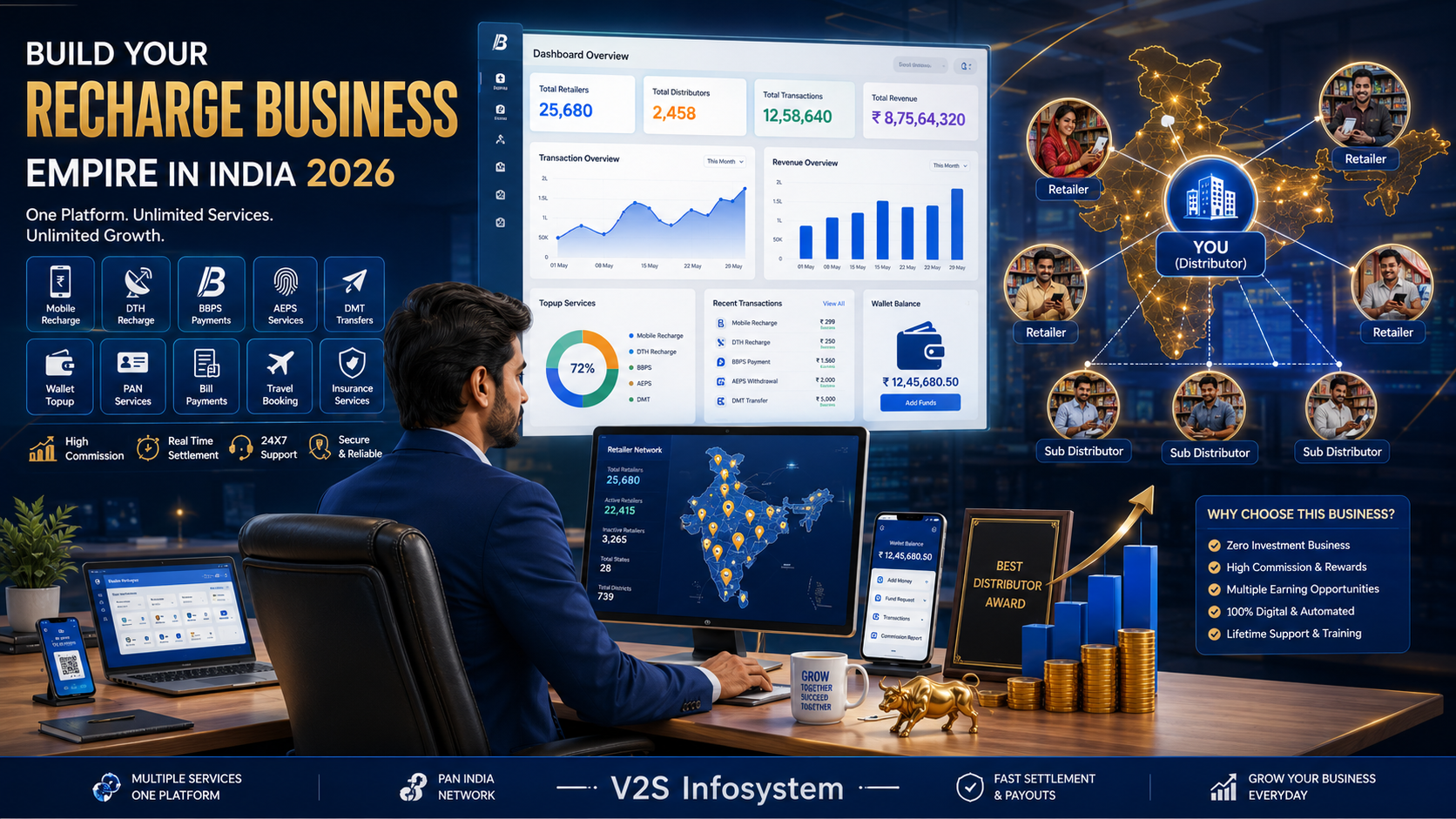
How to Become a Recharge Distributor in India (2026 Complete Guide)
The digital services industry in India continues to grow rapidly, creating new opportunities for entrepreneurs who want to build a profitable recharge distribution business. A recharge distributor plays a critical role in managing retailers, facilitating transactions, and expanding digital payment services across different regions.
With modern B2B recharge software platforms, becoming a recharge distributor is no longer limited to traditional recharge operations. Entrepreneurs can now build large distribution networks that offer mobile recharge, DTH recharge, BBPS bill payments, AePS services, domestic money transfer, insurance services, and many other digital solutions.
Who Is a Recharge Distributor?
A recharge distributor acts as an intermediary between the business administrator (Admin) and the retailers on the ground. The distributor manages retailer onboarding, fund transfers, commission structures, and day-to-day transaction support.
In practical terms, a distributor's job is to grow their retailer base, keep retailer wallets funded, and ensure smooth day-to-day operations across their assigned region. The more active retailers a distributor manages, the higher their monthly income.
In a modern recharge ecosystem, distributors help expand the network while supporting retailers with wallet funding and operational assistance.
How Does a Recharge Distribution Network Work?
Most modern recharge businesses operate using a structured hierarchy.
Version 1 (R1)
Admin → Master Distributor → Distributor → Retailer
Version 2 (R2)
Admin → Master Distributor → Super Distributor → Distributor → Retailer
Each level has its own responsibilities, permissions, commissions, and reporting capabilities. As a distributor, you sit between the Master Distributor above you and the retailers below you. You receive funds from above and distribute them to your retailers, earning a commission spread on every transaction they process.
What Services Can a Recharge Distributor Offer?
A recharge distributor can support retailers with multiple digital services through a centralized platform.
- Mobile Recharge
- DTH Recharge
- BBPS Bill Payments
- Recharge API Services
- AePS Services
- Domestic Money Transfer (DMT)
- UTI PAN Services
- Insurance Services
- LIC Premium Payments
- B2B eCommerce Services
Offering multiple services helps retailers generate more daily transactions, which directly increases the distributor's commission income.
What Is Required to Become a Recharge Distributor?
- Basic business understanding
- Smartphone or computer
- Internet connection
- Bank account
- PAN Card
- Aadhaar Card
- Working wallet balance to fund your retailers
- Access to a reliable recharge software platform
No technical background is required. The distributor panel is managed through a web dashboard and Android app. The most important requirement is choosing a reliable recharge software ecosystem that supports long-term growth.
How to Become a Recharge Distributor: Step-by-Step
Step 1: Understand Your Role and Responsibilities
Before joining a recharge network, be clear on what a distributor is expected to do:
- Onboard and manage retailers in your area
- Transfer wallet balance to retailers when they request funds
- Provide first-level support when retailers face transaction issues
- Monitor daily transaction and commission reports
- Expand your retailer count over time to grow income
Your earnings are directly tied to how many active retailers you have and how many transactions they process daily.
Step 2: Choose the Right Recharge Software Platform
You will operate under an Admin who provides you access to the platform. However, if you plan to eventually launch your own platform, you need to understand what good software looks like. Either way, the quality of the platform you work on affects your daily operations significantly.
A reliable platform should provide:
- Distributor dashboard with real-time transaction visibility
- Retailer management and onboarding tools
- Wallet management and fund transfer features
- Commission tracking at every level
- Android application for on-the-go management
- OTP-based security for all logins
- Multi-service support: recharge, BBPS, AePS, DMT
Businesses planning long-term expansion often choose a B2B Mobile Recharge Software platform that supports complete distribution management.
Step 3: Arrange Your Working Capital
As a distributor, you need wallet balance to fund your retailers. When a retailer requests a top-up, you transfer from your wallet to theirs. Running low on wallet balance means your retailers cannot process transactions — which damages trust and causes them to leave your network.
Start with a comfortable working balance based on your expected daily transaction volume. For a new distributor managing 10–15 retailers, a starting wallet balance of ₹10,000 – ₹25,000 is a reasonable initial buffer, scaling up as your retailer network grows.
Step 4: Recruit Your First Retailers
Start by targeting shop owners who already handle cash transactions daily — mobile phone shops, grocery stores, stationery shops, CSC centres, and general stores. These are natural fits for recharge and bill payment services.
When approaching retailers:
- Explain the commission structure clearly — what they earn per transaction
- Demonstrate how simple the Android app is to use
- Offer fast wallet top-up turnaround — retailers prioritise distributors who respond quickly
- Help them process their first few transactions to build confidence
Focus on quality over quantity early on. Ten active retailers are far more valuable than thirty who rarely transact.
Step 5: Enable Multiple Services for Your Retailers
Do not restrict your retailers to mobile recharge only. Enable every service available on your platform from day one. Retailers who can offer BBPS bill payments, AePS cash withdrawals, and domestic money transfer serve more customers daily — and you earn commission on all of it.
Step 6: Monitor Reports and Support Your Retailers
Check your distributor dashboard daily. Track which retailers are active, which have low wallet balances, and where transaction failures are happening. Fast support is the single biggest reason retailers stay loyal to a distributor. If a transaction fails and the retailer cannot reach you, they will find another distributor.
Step 7: Scale Your Network Consistently
Once your first batch of retailers is running smoothly, begin recruiting the next batch. Set a target — for example, adding 5 new active retailers every month. Consistent expansion is what converts a part-time income into a full-time recharge distribution business.
How Recharge Distributors Earn Revenue
Distributors earn through the commission spread between what the Admin assigns them and what they pass down to retailers. Every transaction a retailer processes generates a small commission that flows up through the network.
Typical commission ranges in the Indian recharge industry:
- Prepaid Mobile Recharge: 1% – 4% per transaction (operator-dependent)
- DTH Recharge: 2% – 3% per transaction
- BBPS Bill Payments: 0.5% – 2% per transaction
- AePS Transactions: ₹5 – ₹15 flat per transaction
- Domestic Money Transfer (DMT): 0.4% – 1% per transaction
As a distributor, your margin is the difference between the commission the Admin credits to you and the commission you pass to your retailers. The wider your spread and the higher your network's daily transaction volume, the greater your monthly earnings.
A distributor managing 20–30 active retailers, each processing moderate daily volumes, can typically earn ₹15,000 – ₹40,000 per month. Earnings scale significantly as the retailer network grows. For a full breakdown of earning potential at each level, see our guide on mobile recharge business investment and profit margin in India.
How to Grow Your Distributor Network
Successful distributors focus on retailer acquisition and long-term retention. Here is what separates high-earning distributors from average ones:
- Recruit active retailers, not just any retailers. A retailer with an existing customer base processes more transactions from day one.
- Respond fast to wallet top-up requests. Retailers judge distributors primarily on fund transfer speed. Be faster than your competition.
- Maintain adequate wallet balance at all times. Never let your wallet run so low that you cannot fund a retailer immediately.
- Enable all available services. Retailers who earn from recharge, BBPS, AePS, and DMT are less likely to leave for another distributor.
- Provide competitive commissions. Research what other distributors in your area are offering and stay competitive.
- Monitor transaction reports weekly. Identify dormant retailers early and re-engage them before they churn.
- Build strong local relationships. In semi-urban and rural markets, personal trust drives retailer loyalty more than any software feature.
Consistent network expansion and strong retailer retention create long-term recurring transaction volume — which is the foundation of sustainable distributor income.
Common Mistakes New Distributors Make
- Choosing unreliable software platforms with poor transaction success rates
- Focusing only on mobile recharge and ignoring BBPS, AePS, and DMT
- Providing slow or no support when retailers face transaction issues
- Maintaining low wallet balances that cause retailer transaction failures
- Not reviewing commission and transaction reports regularly
- Depending on a single service category for all income
- Failing to set a consistent monthly target for new retailer recruitment
Future of Recharge Distribution Business in India
The recharge industry continues to evolve beyond traditional recharges. Modern distribution businesses are increasingly combining recharge services with BBPS, AePS, DMT, insurance, UTI PAN, and other fintech offerings.
As digital service adoption increases across India — particularly in Tier 2, Tier 3 cities and rural areas — recharge distributors who build strong retailer networks and offer multiple services are positioned for stronger, more sustainable business growth.
Entrepreneurs who want to move beyond the distributor role and eventually launch their own recharge platform can read our complete guide on how to start a mobile recharge business in India.
Build a Scalable Recharge Distribution Business
V2S Infosystem Private Limited provides a B2B Mobile Recharge Software platform that helps businesses create and manage complete recharge distribution networks. The platform supports Admin, Master Distributor, Distributor, and Retailer management along with Android applications, reporting systems, wallet management, recharge API reselling, BBPS support, and multiple value-added services.
Entrepreneurs looking to build a long-term recharge distribution business should focus on selecting the right software platform, building a strong retailer network, and offering multiple digital services through a single system.
Frequently Asked Questions
How much investment does a recharge distributor need to start?
The main investment for a distributor is working wallet capital to fund retailers. A starting balance of ₹10,000 – ₹25,000 is typically sufficient for a new distributor managing 10–15 retailers. There is no large upfront fee required to operate as a distributor under an existing Admin.
How much can a recharge distributor earn per month in India?
A distributor managing 20–30 active retailers can typically earn ₹15,000 – ₹40,000 per month from commission spreads across their network. Earnings grow as you onboard more active retailers and expand your service offering beyond basic recharge.
Do I need a GST number to become a recharge distributor?
GST registration requirements vary depending on the Admin platform you operate under and your annual transaction turnover. Check with the platform provider for specific compliance requirements applicable to your business setup.
What is the difference between a distributor and a Master Distributor?
A Distributor manages retailers directly. A Master Distributor manages Distributors (and in R2, Super Distributors) under them. Master Distributors operate at a higher level of the network and typically earn from a larger combined transaction volume, but also carry higher wallet funding responsibility.
Can a distributor become an Admin and launch their own platform?
Yes. Many platform owners started as distributors. Once you understand the business and have an established retailer network, you can upgrade to your own Admin platform. This gives you full control over commissions, branding, and network expansion. See our guide on how to start a mobile recharge business in India for the full process.
Which document is required to become a recharge distributor in India?
Typically you need a PAN Card, Aadhaar Card, a bank account for commission settlement, and a working mobile number. Some platforms may require additional KYC documents depending on their onboarding process.
Conclusion
Becoming a recharge distributor in India in 2026 offers a genuine low-investment business opportunity with scalable income potential. Your earnings grow directly with the size and activity of your retailer network — making consistent retailer recruitment and strong support the two most important factors for success.
Start with the right software platform, maintain adequate wallet balance, enable multiple services for your retailers, and focus on building active retail relationships in your region.
V2S Infosystem Private Limited provides the B2B Mobile Recharge Software platform to help you manage your entire distribution network from a single dashboard. Explore the available plans and start building your recharge distribution business today.