How to Start a Mobile Recharge Business in India in 2026
Start your own mobile recharge business in India with low investment and high growth potential. Learn the complete process, business model, required software, distributor network, commission structure, and how to scale your recharge business successfully in 2026.
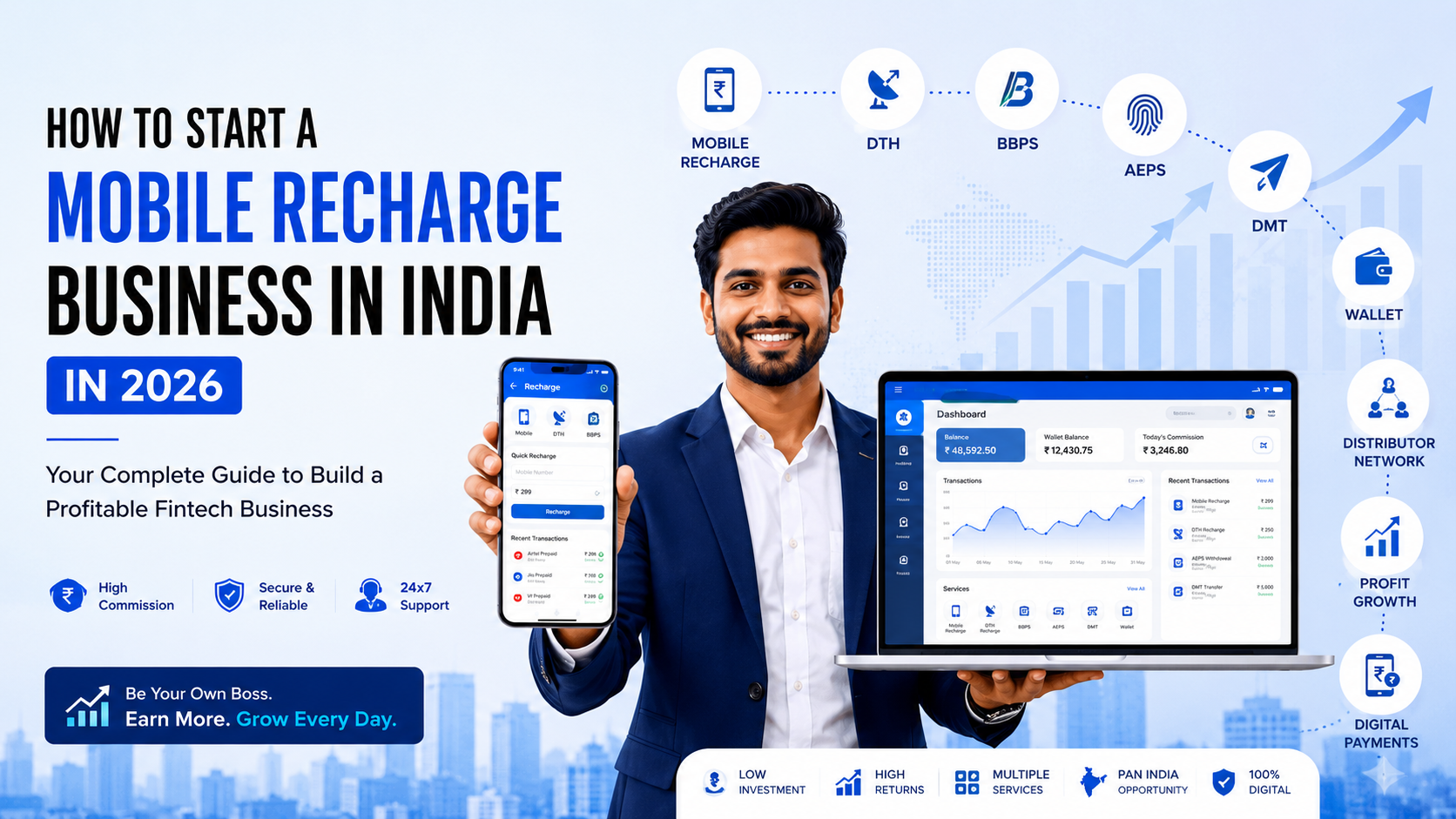
How to Start a Mobile Recharge Business in India in 2026
The digital payment ecosystem in India continues to expand, creating significant opportunities for entrepreneurs who want to build their own mobile recharge business. With growing demand for mobile recharges, DTH services, bill payments, Aadhaar-enabled services, money transfer solutions, and digital financial products, a recharge business can generate recurring revenue while serving both urban and rural customers.
Unlike traditional recharge shops that depend only on direct customer transactions, modern entrepreneurs can now launch their own recharge software platform, build a distributor network, and operate a complete digital services ecosystem.
What Is a Mobile Recharge Business?
A mobile recharge business allows customers and retailers to perform prepaid recharges, postpaid bill payments, DTH recharges, utility bill payments, and other digital services through a centralized platform.
Modern recharge platforms typically include:
- Mobile Recharge
- DTH Recharge
- BBPS Bill Payments
- Recharge API Reselling
- AePS Services
- Domestic Money Transfer (DMT / DMR)
- UTI PAN Services
- Insurance Services
- LIC Premium Payments
- B2B eCommerce Services
The business owner earns revenue through commissions, service charges, distributor activity, retailer transactions, and value-added digital services.
Why Start a Mobile Recharge Business in 2026?
India continues to witness rapid adoption of digital payments and fintech services. Millions of recharge and bill payment transactions are processed every day, creating opportunities for entrepreneurs to build scalable digital businesses.
Key advantages include:
- Low monthly startup cost — software plans start from ₹1,499/month
- No software development required
- Recurring income from commissions across your entire network
- Ability to build and manage a multi-level distributor network
- Multiple revenue streams beyond basic recharge
- Growing demand for digital financial services in urban and rural India
- Scalable business model — start small, expand gradually
- Android app availability for all users in the network
How to Start a Mobile Recharge Business in India: Step-by-Step
Here is the complete process to launch your own mobile recharge business as a platform owner (Admin), not just a retailer.
Step 1: Decide Your Business Model
Before anything else, decide which level you want to operate at:
- Retailer: You serve end customers directly and earn per-transaction commissions. Low investment, limited scale.
- Distributor: You onboard retailers under you and earn from their collective transaction volume.
- Admin (Platform Owner): You own and operate the entire recharge platform, manage distributors and retailers, set commissions, and earn from every transaction across your network. This is the highest-earning model.
Most entrepreneurs looking to build a long-term business should target the Admin model from the beginning. See our detailed guide on how to become a recharge distributor in India if you want to start at the distributor level first.
Step 2: Arrange Your Basic Requirements
You need only a few basic resources to get started:
- Computer or Laptop
- Internet Connection
- Business Bank Account
- PAN Card
- Aadhaar Card
- Business Mobile Number
- Working Capital for Wallet Management
No coding or software development experience is required to operate the platform.
Step 3: Choose the Right B2B Recharge Software
The software platform is the foundation of your entire business. A poor choice here directly impacts transaction success rates, user experience, and your ability to scale.
Important features to look for in a recharge software platform:
- Admin, Master Distributor, Distributor, and Retailer panels
- Wallet management and fund transfer system
- Commission management at each level
- Recharge API reselling capability
- BBPS, AePS, and DMT integration support
- Android application for all user levels
- OTP-based login security
- Transaction reporting and analytics
- Multi-language support
- UTI PAN and Insurance service support
V2S Infosystem Private Limited provides a subscription-based B2B Mobile Recharge Software platform built for entrepreneurs who want to launch and manage their own recharge distribution network.
Step 4: Select Your Software Version
Two versions are available depending on your business scale:
- Version 1 (R1) — ₹1,499/month: 4-level network — Admin → Master Distributor → Distributor → Retailer. Best for businesses starting out or operating in a single region.
- Version 2 (R2) — ₹1,999/month: 5-level network — Admin → Master Distributor → Super Distributor → Distributor → Retailer. Includes White Label Admin branding. Best for businesses targeting multi-region expansion.
For a full breakdown of investment costs, API charges, and earning potential at each level, read our detailed guide on mobile recharge business investment and profit margin in India.
Step 5: Integrate Recharge APIs
Your software platform needs to be connected to recharge API providers to process live transactions. API integration is typically a one-time setup cost ranging from ₹1,000 to ₹5,000 per API depending on the service type (recharge, BBPS, AePS, DMR).
Choosing a reliable API provider with a high transaction success rate (99%+) is critical. A failing API means failed recharges, which directly damages retailer trust and your business reputation.
Step 6: Fund Your Wallet
Before your platform goes live, you need adequate working capital in your admin wallet. This balance flows down to distributors and retailers as they request funds. Start with a comfortable buffer — running low on wallet balance causes transaction failures at the retailer level.
Step 7: Onboard Your First Distributors and Retailers
Start by recruiting 2–5 distributors in your target region. Each distributor will then onboard retailers under them. Focus on:
- Recruiting distributors with existing retailer relationships
- Providing fast onboarding and setup support
- Offering competitive commission margins to attract active users
- Helping new retailers process their first transactions smoothly
Your transaction volume — and therefore your income — grows directly with the number of active retailers in your network.
Step 8: Expand Your Service Offering
Do not limit your platform to mobile recharge only. Add the following services as early as possible to increase per-user revenue and network stickiness:
- BBPS Bill Payments (electricity, gas, water, broadband)
- AePS Services (Aadhaar-based cash withdrawals)
- Domestic Money Transfer (DMT / DMR)
- Recharge API Reselling
- UTI PAN Services
- LIC and Insurance Services
Retailers who can offer more services generate more daily transactions, which means higher commission income for you as the Admin.
Step 9: Monitor Reports and Optimise
Once the platform is live, review transaction reports, wallet activity, and commission performance regularly. Identify:
- Which distributors are active and which are dormant
- Which services have the highest transaction volume
- Where wallet balance issues are occurring
- Which APIs have the highest failure rates
Regular monitoring allows you to fix problems early and keep your network growing smoothly.
Additional Services That Increase Income
Successful recharge businesses generate revenue from far more than mobile recharges. Every additional service you enable becomes an extra income stream across your entire retailer network.
- BBPS Bill Payments
- AePS Services
- Domestic Money Transfer (DMT)
- Recharge API Reselling
- UTI PAN Services
- LIC Payments
- Insurance Services
- B2B eCommerce Services
- Offline Electricity Bill Collection
Offering multiple services also reduces your risk — if recharge commission rates on one operator drop, income from other services compensates.
Common Mistakes to Avoid
- Choosing an unreliable software provider with poor support
- Using unstable APIs with low transaction success rates
- Maintaining insufficient wallet balance at the admin level
- Ignoring distributor recruitment and network expansion
- Offering only mobile recharge and skipping BBPS, AePS, DMR
- Not monitoring transaction and commission reports regularly
- Providing slow support to retailers, causing them to switch platforms
- Not planning commission margins across distributor levels before launch
Future of the Recharge Business in India
The future of the recharge business remains strong due to continued growth in digital payments, financial inclusion, and fintech adoption across India. Businesses that combine recharge services with BBPS, AePS, DMT, UTI PAN, insurance, and API reselling are expected to generate stronger and more stable revenue than recharge-only operations.
As more businesses and retailers move toward digital service platforms, demand for scalable recharge software solutions is expected to continue growing well beyond 2026.
Frequently Asked Questions
How much does it cost to start a mobile recharge business in India in 2026?
You can start a B2B mobile recharge software business from ₹1,499 per month. One-time API integration costs range from ₹1,000 to ₹5,000 per API. You also need working capital for your admin wallet, which varies based on your network size and daily transaction volume.
Do I need technical knowledge to start a recharge business?
No. Modern B2B recharge software platforms are designed for non-technical users. You manage everything through a web-based admin panel and Android app. No coding or software development experience is required.
What is the difference between a recharge retailer and a recharge platform owner?
A retailer processes transactions for end customers and earns small per-transaction commissions. A platform owner (Admin) builds and manages an entire network of distributors and retailers, earning a margin on every transaction processed across the whole network. The Admin model has significantly higher earning potential.
How many distributors and retailers do I need to make the business profitable?
Even a small network of 3–5 active distributors, each managing 10–15 retailers, can generate meaningful monthly income. Profitability grows as you expand the network. Focus on retailer activity, not just retailer count.
Can I offer services beyond mobile recharge?
Yes. A good B2B recharge platform supports BBPS bill payments, AePS, domestic money transfer, UTI PAN services, insurance, recharge API reselling, and more — all from the same admin panel. Offering more services increases per-user revenue across your network.
What is the difference between R1 and R2 software versions?
R1 is a 4-level network (Admin, Master Distributor, Distributor, Retailer) at ₹1,499/month. R2 adds a Super Distributor level (5-level network) and includes White Label Admin branding at ₹1,999/month. R2 is better suited for businesses planning multi-region expansion.
Conclusion
Starting a mobile recharge business in India in 2026 is no longer limited to becoming a retailer. Entrepreneurs can now launch their own recharge software platform, manage a full distributor-retailer network, and build multiple revenue streams through digital financial services — all with a monthly investment starting from ₹1,499.
The key to success is choosing the right software, recruiting active distributors and retailers, offering multiple services beyond basic recharge, and monitoring your network consistently.
V2S Infosystem Private Limited offers a complete B2B Mobile Recharge Software solution including recharge services, API reselling, BBPS, AePS, DMT, UTI PAN services, Android applications, and full network management. Explore the available plans and start building your recharge business network today.