Best Mobile Recharge Software in India — What to Look For Before You Buy
Compare the best B2B mobile recharge software companies in India — features, pricing, API support, and what to look for when choosing a recharge platform.
Best Mobile Recharge Software in India — What to Look For Before You Buy
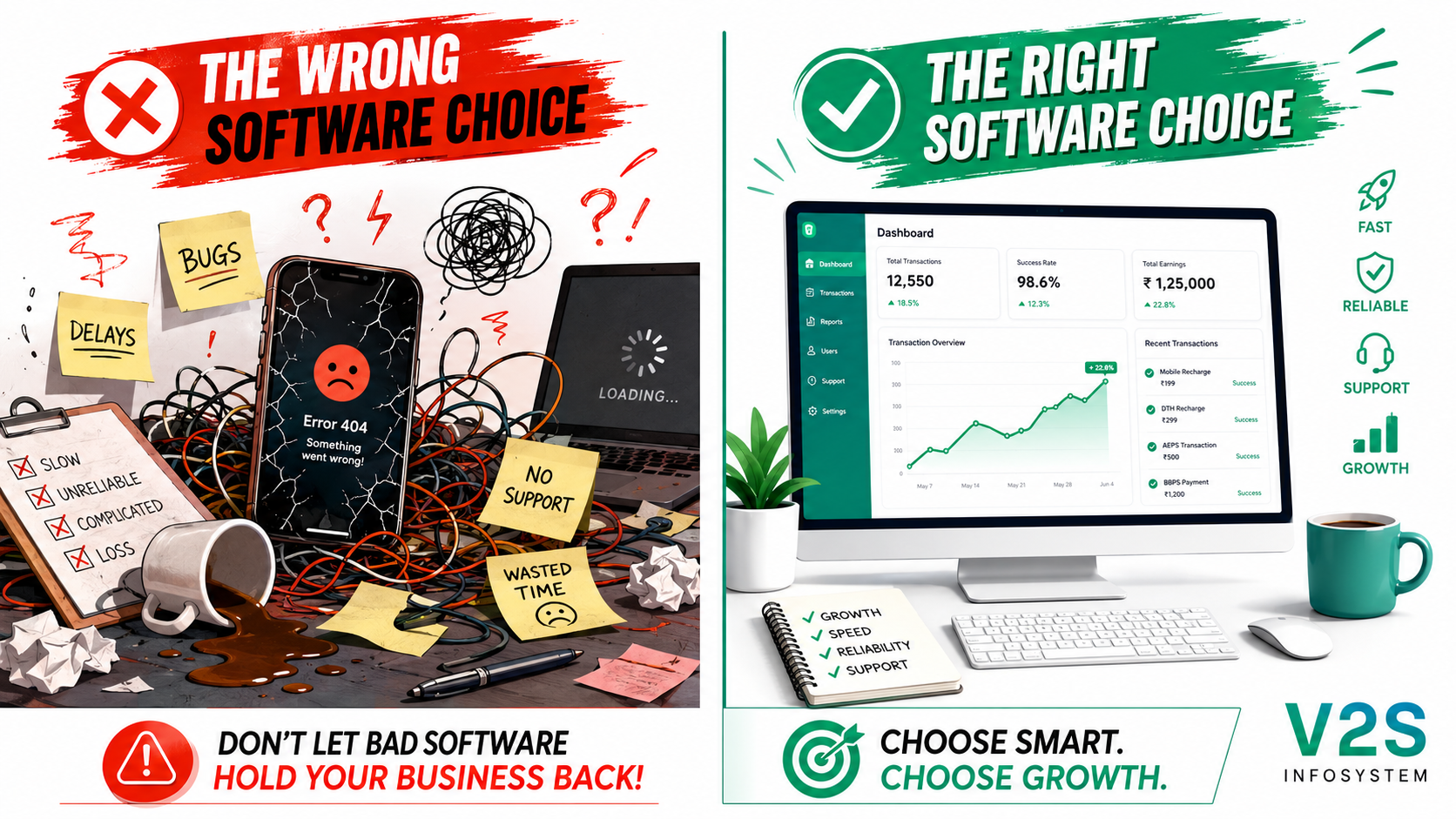
India has dozens of B2B mobile recharge software providers. Most of them look similar at first glance — they all claim multi-operator support, admin panels, and competitive commissions. But the differences between a good platform and a poor one become very clear within the first 30 days of running your business on it. A failed recharge during peak hours, a frozen wallet, a support ticket that goes unanswered for three days — these are not minor inconveniences. They are business losses that compound over time.
This guide does not give you a ranked list of company names. What it does give you is the exact framework used by serious distributors and admins in India to evaluate recharge software before committing — and the specific questions you should ask any provider before signing up. If you apply this framework, the right choice becomes obvious quickly.
Why Choosing the Wrong Recharge Software Is Costly
Switching recharge software after you have onboarded 50 retailers and configured 8 API operators is extremely disruptive. Your retailers need retraining. Your API integrations need to be rebuilt. Your wallet histories and transaction records may not migrate cleanly. Your downline loses confidence during the transition period.
Most businesses that switch platforms do so because of one of these reasons:
- The original software had a single API connection with no backup routing — one API going down meant the entire business stopped
- Commission configuration was rigid — the admin could not set different slabs for different partner levels
- The software could not scale — performance degraded as retailer numbers grew
- Support response times were too slow for a transaction-dependent business
- The white-label feature was underdeveloped — custom domains were technically possible but practically unreliable
Every one of these problems is avoidable if you evaluate the right things upfront. Here is what to look at.
Criterion 1 — API Gateway Architecture
This is the most important technical criterion and the one most buyers underestimate. The API gateway is the engine that processes every recharge transaction. If it is poorly designed, no amount of good UI or cheap pricing compensates for it.
What to ask and verify:
- How many API providers can I connect? Any limit — even a generous one — is a constraint on your business. The best platforms impose no limit on API connections.
- Do you support both GET and POST request methods? Different operator API providers use different methods. A platform that supports only one method forces you to work with fewer API providers.
- Is there primary and secondary routing per operator? If your primary API for Airtel goes down, does the system automatically switch to your secondary Airtel API, or does it fail every Airtel recharge until you manually intervene? Automatic failover routing is not optional — it is a baseline requirement.
- Is amount-based routing available? Routing a ₹19 recharge and a ₹2,999 recharge through the same API regardless of success rates is inefficient. Better platforms let you route high-value recharges to your most reliable API.
- Does the callback system support IP allow-listing? Without IP filtering on callbacks, your transaction confirmations are vulnerable to spoofed status updates.
- Can I configure custom headers and timeouts per API? Every operator's API behaves differently. One-size-fits-all timeout settings cause unnecessary failures on slower APIs.
V2S Infosystem's platform supports unlimited API connections, both GET and POST methods, operator-level primary and secondary routing, amount-based routing, full callback configuration with IP allow-listing, and per-API custom headers and timeouts. See the complete platform features for the full API specification.
Criterion 2 — LAPU Recharge Integration
LAPU (Live Agent Prepaid Utility) recharge is a specific recharge method used by certain operator API configurations. Not all software platforms handle LAPU correctly — many treat it as an edge case rather than a core workflow.
What to verify:
- Is LAPU recharge natively integrated or is it a separate add-on module?
- Is real-time LAPU balance visible in the admin panel without switching to a separate interface?
- Is the transaction history for LAPU recharges included in the same reporting interface as standard recharges?
- Can LAPU connections be configured through the same API gateway used for standard recharge, or does it require separate setup?
Platforms that handle LAPU as an afterthought will create operational friction for businesses that rely on it regularly. Verify with a live demo before committing.
Criterion 3 — Multi-Level Channel Architecture
The channel structure determines how your business scales. A 3-level system works fine if you are small. Once you grow, you need a 4 or 5-level system with cleanly separated roles and permissions.
What to look for:
- How many levels does the platform support? Minimum viable for a serious distribution business: Admin, Master Distributor, Distributor, Retailer. A 5-level system adds Super Distributor between Master Distributor and Distributor — useful for large geographic networks.
- Are commission slabs configurable per level per service? You need to be able to set a different commission for mobile recharge vs DMT vs BBPS, and a different slab for distributor vs master distributor — independently. Rigid global commission settings are a sign of an under-engineered platform.
- Is there a member-specific API override? For premium or white-label partners, you may want to assign specific APIs rather than the default routing. This requires member-level API override capability.
- Is wallet management separate per level? Each role should have its own wallet, fund request flow, and approval workflow. Shared or pooled wallets create accounting confusion and disputes.
Criterion 4 — White-Label Capability
If you plan to offer your platform under your own brand, white-label is not a feature — it is a core infrastructure requirement. Evaluate it like one.
- Does white-label support a fully custom domain — not just a subdomain of the provider's domain?
- Does the Android app rebrand fully, or does the provider's name appear anywhere in the app?
- Can white-label partners add their own API providers independently, or are they forced to use only the APIs you configure?
- Is there a dedicated IP included in the white-label plan, or is it an additional charge?
- Can multiple white-label accounts be created under one admin — and is there a limit?
V2S Infosystem's R2 plan includes white-label admin panel support with custom domain, white-label API control, and unlimited white-label account creation. Dedicated IP is available as an add-on.
Criterion 5 — Service Coverage Beyond Recharge
A recharge-only platform limits your retailer network's earning potential. The best platforms integrate additional services that increase per-retailer monthly income without requiring separate software or separate wallets.
Verify what is included and what is an additional cost:
- BBPS — all biller categories, complaint management, real-time bill fetch
- AePS — cash withdrawal, balance enquiry, mini statement via Aadhaar biometric
- DMT — IMPS-based domestic money transfer with multi-gateway support
- Android app — for retailers who operate from smartphones, not computers
- UTI PAN, insurance, and other services — whether bundled or available as add-ons
A retailer running recharge, BBPS, AePS, and DMT from one platform earns 3–5x more per month than a retailer limited to recharge alone. This directly impacts the attractiveness of your network to new retailers — and therefore the growth rate of your distributor income.
Criterion 6 — Platform Architecture and Reliability
This is where most buyers make the biggest mistake — they never ask about it at all, and the provider never volunteers the information. Platform architecture directly determines two things: how the software behaves at high transaction volume, and how quickly bugs get introduced when new features are added.
You do not need to understand the technical details. You need to ask the right questions:
- What is the average platform uptime over the last 6 months? Any serious provider tracks this. If they cannot answer, that is your answer.
- How is the platform built to handle large transaction volumes without degradation? Look for mentions of caching, database optimisation, and load management. Vague answers mean the platform has not been engineered for scale.
- How long has the platform been in active use, and what is the average client retention period? Client retention is the most honest proxy for platform reliability. A platform that clients have been running on for 3+ years without switching is demonstrably reliable.
- Is the codebase maintained and regularly updated? Ask when the last major platform update was. Stale codebases accumulate technical debt that eventually causes reliability issues.
V2S Infosystem's platform has been revamped on an enterprise-grade architecture following SOLID and DRY principles with a caching layer and database optimisation for high-volume concurrent transactions. Active clients have been running on the platform for 3+ years without switching — the strongest reliability signal available.
Criterion 7 — Pricing Model and Total Cost of Ownership
The subscription price is only one part of the total cost. Evaluate the full picture:
- Subscription fee: monthly or annual, and what is included at base price
- API integration cost: is there a per-API setup fee? What is the range?
- Storage and server costs: what is the base allocation, and what does extra cost?
- SMS gateway: is it included, or do you bring your own?
- White-label and dedicated IP: included in a plan or separate charge?
- Hidden costs: ask specifically whether there are any charges not listed in the standard pricing
V2S Infosystem's pricing is transparent and subscription-based:
- R1 Plan — ₹1,499/month: 4-channel setup (Admin, Master Distributor, Distributor, Retailer). No white-label.
- R2 Plan — ₹1,999/month: 5-channel setup with White-Label Admin Panel included.
- API integration: ₹1,000–₹5,000 one-time per API provider
- Base storage: ~1 GB server + 1 GB database included. Extra storage from ₹1,000/month.
- SMS: ₹0.20/SMS or bring your own SMS gateway at no extra charge
No recharge balance purchase required — you manage your own API balance directly. No lock-in — monthly subscription means you can evaluate and exit without a long-term commitment.
Criterion 8 — Support Quality
Recharge is a real-time transaction business. A failed transaction at 9 PM on a Saturday is not a situation where you can wait until Monday morning for a response. Support quality is not a soft factor — it is an operational requirement.
- What are the support hours? Is there weekend coverage?
- What channels are available — phone, WhatsApp, email, ticket system?
- What is the average first-response time for production issues?
- Is there a dedicated account manager for distributor and admin level clients?
Ask for this information in writing before signing up. Vague assurances of "24/7 support" without specifics about response time commitments are not reliable.
Red Flags — What to Avoid
These are warning signs that a recharge software platform is likely to cause problems:
- Single API connection only — no backup routing means your business stops whenever the API provider has an issue
- No demo or trial access — a provider who will not let you test the admin panel before paying has something to hide about the user experience
- Commission structure not configurable by you — if the provider controls your commission slabs, you have no control over your own business margin
- No Android app included — retailers in India predominantly operate from smartphones; a web-only platform limits your retailer network significantly
- Support only via email with no phone or WhatsApp — unacceptable for a transaction-dependent business
- Source code sale model — platforms sold as one-time source code purchases receive no updates, no maintenance, and no support after the initial sale. You are on your own when bugs appear or new operator APIs need to be integrated.
- Extremely low pricing with no explanation of cost structure — if a platform is priced at ₹500/month with "unlimited everything," ask how they sustain the infrastructure. The answer is usually that they cannot.
Why V2S Infosystem
V2S Infosystem has been building and maintaining B2B recharge software since 2015. The platform has been continuously developed — not sold as a static product — with active clients running on it for over 3 years without switching. The current platform is built on enterprise-grade architecture following SOLID and DRY engineering principles, with a caching layer and database optimisation for high-volume concurrent transactions.
Key differentiators against the evaluation criteria above:
- Unlimited API connections — no cap, any operator, GET and POST support
- LAPU recharge natively integrated — not an add-on
- 4-channel (R1) and 5-channel (R2) architecture with per-level, per-service commission configuration
- White-label admin panel included in R2 — custom domain, unlimited white-label accounts
- BBPS, AePS, DMT, UTI PAN, insurance, flight booking, loan repayment — all from one platform
- Native Android app for retailers and admins — included at no extra charge
- Monthly subscription — no lock-in, no large upfront cost, no source code sale
- Active development — the platform is regularly updated, not frozen
See the full features and capabilities page for a detailed breakdown of every feature currently available on the platform, or view the B2B admin panel plans and pricing to get started.
Frequently Asked Questions
What is the best B2B mobile recharge software in India?
The best platform for your business depends on your specific requirements — channel depth, white-label need, service mix, and budget. The evaluation criteria in this guide cover the key factors. For a subscription-based B2B platform with unlimited API support, LAPU integration, multi-level channel architecture, and full BBPS/AePS/DMT coverage, V2S Infosystem's platform covers all of these from a single subscription starting at ₹1,499/month.
What is the difference between recharge software and a recharge API?
A recharge API is a technical integration that connects your system to an operator's recharge processing backend. Recharge software is a complete business management platform — it includes the API gateway, plus admin panel, wallet management, commission configuration, distributor and retailer management, transaction reporting, Android app, and support for additional services like BBPS and AePS. If you want to run a distribution business with a network of retailers, you need software, not just an API.
Should I buy recharge software outright or subscribe monthly?
Monthly subscription is strongly preferable for most businesses. With a subscription model, the provider has an ongoing incentive to maintain, update, and support the platform. With a one-time source code sale, updates and support effectively end after the initial sale. Monthly pricing also means lower upfront commitment — you can evaluate actual platform performance before deciding to continue long term.
How many operators can I add to B2B recharge software?
On a well-engineered platform like V2S Infosystem's, there is no operator limit. You can add Jio, Airtel, Vi, BSNL for mobile recharge, all major DTH providers, and any other operator whose API you have access to. Each operator connection is independently configured with its own routing, method, and fallback settings.
Is LAPU recharge supported in modern B2B recharge software?
It depends on the platform. LAPU recharge requires native integration at the API gateway level — it is not a standard recharge workflow. V2S Infosystem's platform has LAPU integration built in as a core feature, not a separate module or add-on. Always verify this specifically with any provider you are evaluating, and request a live demo of LAPU processing before committing.
Can I offer BBPS, AePS, and DMT from the same recharge software platform?
Yes, on platforms that integrate these services. V2S Infosystem's software includes BBPS bill payments, AePS Aadhaar banking, and DMT domestic money transfers alongside mobile recharge — all under one login, one wallet, and one Android app. This allows your retailers to serve customers for multiple services in a single visit, significantly increasing per-retailer monthly income compared to recharge-only platforms.
What should I check before choosing a recharge software provider?
The eight criteria covered in this guide: API gateway architecture (unlimited connections, GET/POST, automatic failover routing), LAPU integration, multi-level channel structure, white-label capability, service coverage beyond recharge, platform architecture and reliability, transparent pricing with total cost of ownership, and support quality with specific response time commitments. Do not rely on marketing claims alone — request a live admin panel demo and ask specifically about each criterion before making a decision.
Ready to evaluate V2S Infosystem's platform directly? View plans and pricing → | See complete platform features → | Request a demo →