How Much Does a Web Application Cost? (2026 India Guide)
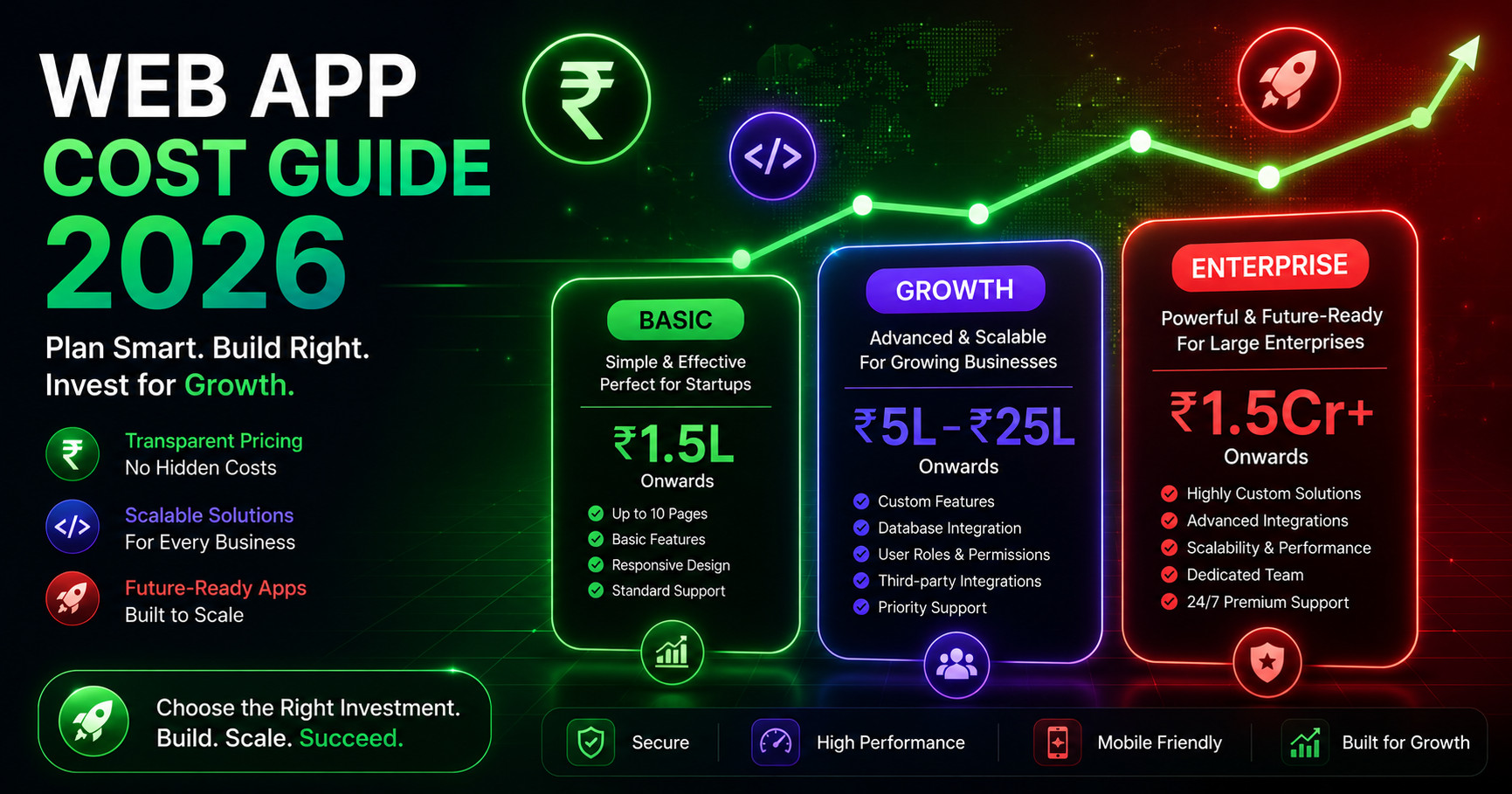
Web app costs in India range from ₹1.5L to ₹1.5Cr+. This guide breaks down the 8 factors that determine your actual cost.
How Much Does a Web Application Cost? (2026 India Guide)
This is the question every business owner asks before starting a software project — and almost nobody gives a straight answer. Most agencies say "it depends" and ask for a discovery call. We're going to do better than that.
Web application development costs in India in 2026 range from ₹1.5 lakh for a simple MVP to ₹1.5 crore or more for a complex enterprise platform. That's a 100x range — and there's a logical reason for every point on it.
This guide breaks down exactly what drives cost, gives you real price ranges for different types of projects, and helps you figure out where your project fits before you talk to a single vendor.
The Three Broad Cost Tiers
Tier 1: Simple Web Apps — ₹1.5L to ₹5L
These are single-purpose tools with limited user roles and no complex integrations. Examples include basic booking forms, lead capture portals, simple inventory trackers, or internal dashboards with read-only data. Typically 4–8 weeks to build with a small team. No mobile app, no payment gateway, no real-time features.
Tier 2: Mid-Complexity Apps — ₹5L to ₹25L
This is where most business web applications land. Role-based user access, payment integration, third-party APIs, custom workflows, reporting dashboards, and mobile-responsive design. Examples: a delivery tracking portal, a B2B ordering system, a customer self-service portal, or a multi-vendor marketplace with 2–3 user roles. Typically 3–6 months to build.
Tier 3: Complex / Enterprise Apps — ₹25L to ₹1.5Cr+
These are full platforms — ERP systems, multi-tenant SaaS products, apps serving thousands of concurrent users, platforms with AI/ML components, or systems requiring deep integration with legacy software. Timeline: 6–18+ months. These projects need architecture planning, dedicated QA, and ongoing maintenance from day one.
The 8 Factors That Determine Your Actual Cost
1. Number of User Roles
Every user role is essentially a separate mini-application. A platform with Admin, Manager, and Customer roles requires three distinct interfaces, three permission systems, and three times the testing surface. Each additional role typically adds 15–25% to development cost.
2. Third-Party Integrations
Connecting your app to payment gateways (Razorpay, PayU), SMS providers, GST APIs, shipping partners, or ERP systems requires custom API work. Each integration adds 1–3 weeks and ₹50K–₹2L per connection depending on complexity and documentation quality.
3. Mobile App Requirement
If you need a mobile app alongside the web app, expect to add 40–70% to the total project cost. Cross-platform (Flutter/React Native) is cheaper than native (separate iOS + Android) but comes with trade-offs on performance and device-specific features.
4. Real-Time Features
Live GPS tracking, real-time chat, live order status updates, or collaborative editing require WebSocket infrastructure and different architecture decisions. These features add significant backend complexity — typically ₹1L–₹5L depending on scale.
5. Custom Reporting and Analytics
A simple data table is cheap. A fully custom analytics dashboard with date filtering, drill-down charts, export to Excel, and role-specific views is a substantial development effort — often 3–5 weeks of work in itself.
6. Security and Compliance Requirements
Apps handling financial data, health records, or sensitive personal information need additional security architecture — encryption, audit trails, penetration testing, and compliance review. Budget ₹1L–₹5L for security-critical applications.
7. Scalability Requirements
An app for 50 internal users can be built simply. An app expected to serve 50,000 customers requires different architecture, load balancing, caching strategy, and database design — which costs more to build correctly from the start.
8. UI/UX Design Investment
Wireframes and basic design: ₹50K–₹1L. Full UX research, user testing, and polished design system: ₹2L–₹8L. Many projects underinvest here and pay for it in user adoption and support costs later.
In-House vs Agency vs Freelancer: Cost Comparison
In-house team: ₹8L–₹20L+ per year per developer (salary + overhead). Full control, but slow to hire and expensive to maintain between projects.
Freelancers: ₹500–₹2,000/hour. Cheaper short-term but risky for complex projects — coordination overhead, availability gaps, and no accountability for the full product.
Development agency: ₹3,000–₹8,000/hour or fixed-price project. Higher upfront cost but full team (PM, developers, QA, designer), structured delivery, and single point of accountability. Best fit for anything above Tier 1.
What's Usually Not Included in a Quote
Always ask agencies to clarify what's excluded. Common omissions include: hosting and infrastructure costs (₹2K–₹20K/month), SSL certificates, third-party API subscription fees, post-launch bug fixes beyond a warranty period, and content entry or data migration.
How to Get an Accurate Quote
The more specific you are, the more accurate the quote. Before approaching any vendor, prepare: a list of user roles, a list of core features per role, any third-party systems you need to integrate, your expected user volume at launch and at 12 months, and your preferred tech stack (or openness to recommendations).
A good agency will return a fixed-price quote with a clear scope, a change control process, and a payment schedule tied to deliverables — not hours.
What V2S Infosystem Builds
V2S Infosystem Private Limited builds custom web applications for Indian and international businesses — from mid-complexity portals to full enterprise platforms. All projects are fixed-price with full source code delivery. Contact us to get a scope-based estimate for your project.